
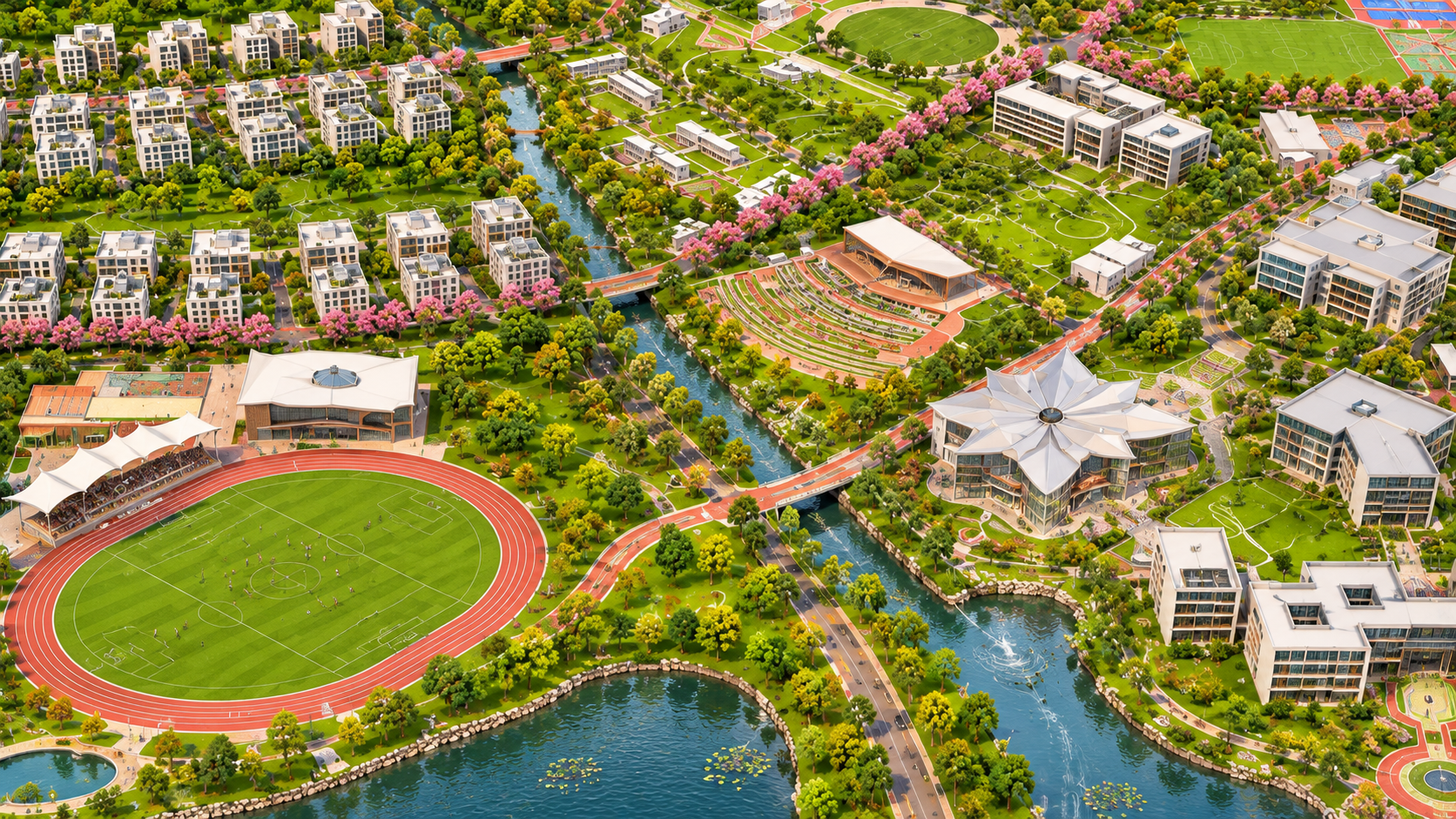
The masterplan for the Indian Institute of Technology Tirupati envisions a comprehensive academic campus across a 511.03-acre site, designed to support the institute's long-term educational, research and residential requirements. Having initially commenced operations in a temporary facility at Chadalawada Nagar in August 2015, IIT Tirupati is developing a permanent campus that will accommodate its growing student population and academic infrastructure.


The 511.03-acre site presents varied topographical conditions, with less than 55% of the land suitable for development across different pockets. The southern portion offers a larger contiguous area for the main campus, while the central and northern pockets feature smaller, undulating land parcels.
Several planning alternatives were evaluated before arriving at a compact campus arrangement. The masterplan establishes clearly defined land parcels according to their size, shape and development potential, ensuring an organised relationship between academic, residential and recreational functions.
The campus development follows a phased approach, initially planning for an intake of 2,500 students with provision for subsequent expansion. The masterplan incorporates a further development phase intended to increase student capacity to 5,000, while the broader campus planning considers long-term growth to accommodate more than 12,500 students.
This flexible planning framework allows academic infrastructure, student accommodation and associated facilities to develop progressively while maintaining the overall campus structure.

The design integrates the natural topography, landscaped open spaces and water features into the campus framework. Internal roads, pedestrian connections and green corridors establish movement networks between academic and residential zones.
The arrangement of buildings and open spaces responds to the site's natural character, creating a balanced institutional environment that encourages interaction, supports outdoor activities and provides opportunities for future development.